The Science of Indoor Air
The air you breathe
is invisible.
Its effects are not.
You'll breathe 2,300 gallons of air today.
Most of it indoors.
Almost none of it monitored.
The Invisible Variable
We optimize everything
except what we breathe.
We track our steps.
Our sleep. Our heart rate.
But the air we move through
remains entirely unmonitored.
spent indoors
than outdoor air ¹
Carbon Dioxide
CO₂ is not just a byproduct.
It is a signal your body
cannot ignore.
Your brainstem monitors CO₂
every second you're alive.
At 1,000 ppm — a typical bedroom by midnight —
function ²
At 1,000 ppm — a typical bedroom by midnight —
function ²
At 2,500 ppm — a stuffy room with windows sealed —
making ability ²
At 2,500 ppm — a stuffy room with windows sealed —
making ability ²
A single sleeping adult
raises bedroom CO₂ from 450 ppm
to above 1,500 ppm
within 90 minutes.
CO₂ & Sleep
What happens to your sleep
while the air in your bedroom
accumulates.
Bedroom CO₂ is a signal
of how well your room
is ventilated.
Lower overnight CO₂ has been associated
with deeper sleep, better sleep quality,
and improved next-day performance. ⁵
Elevated CO₂ during sleep
may be one of the most prevalent
and least understood contributors
to non-restorative sleep.
"Present in most bedrooms.
Detectable with a $200 sensor.
Almost never discussed."
Beyond CO₂
CO₂ is the loudest signal.
But it isn't
the only one.
A heat wave in Boston, 2018. Students without AC —
times ⁹
A heat wave in Boston, 2018. Students without AC —
times ⁹
Highest PM2.5 exposure carries roughly —
poor sleep efficiency ¹¹
Highest PM2.5 exposure carries roughly —
poor sleep efficiency ¹¹
Plants
Humans have lived with plants
for ten thousand years.
The science is finally
catching up.
In 1984, Roger Ulrich measured
what a view of trees did
to post-surgical patients.
Shorter hospital stays.
Less pain medication.
Just a window. ³
Plants under adequate light
actively sequester CO₂
through photosynthesis —
measurably slowing accumulation.
"The presence of plants reduced
salivary cortisol and anxiety
within 5 minutes." ⁷
with biophilic design
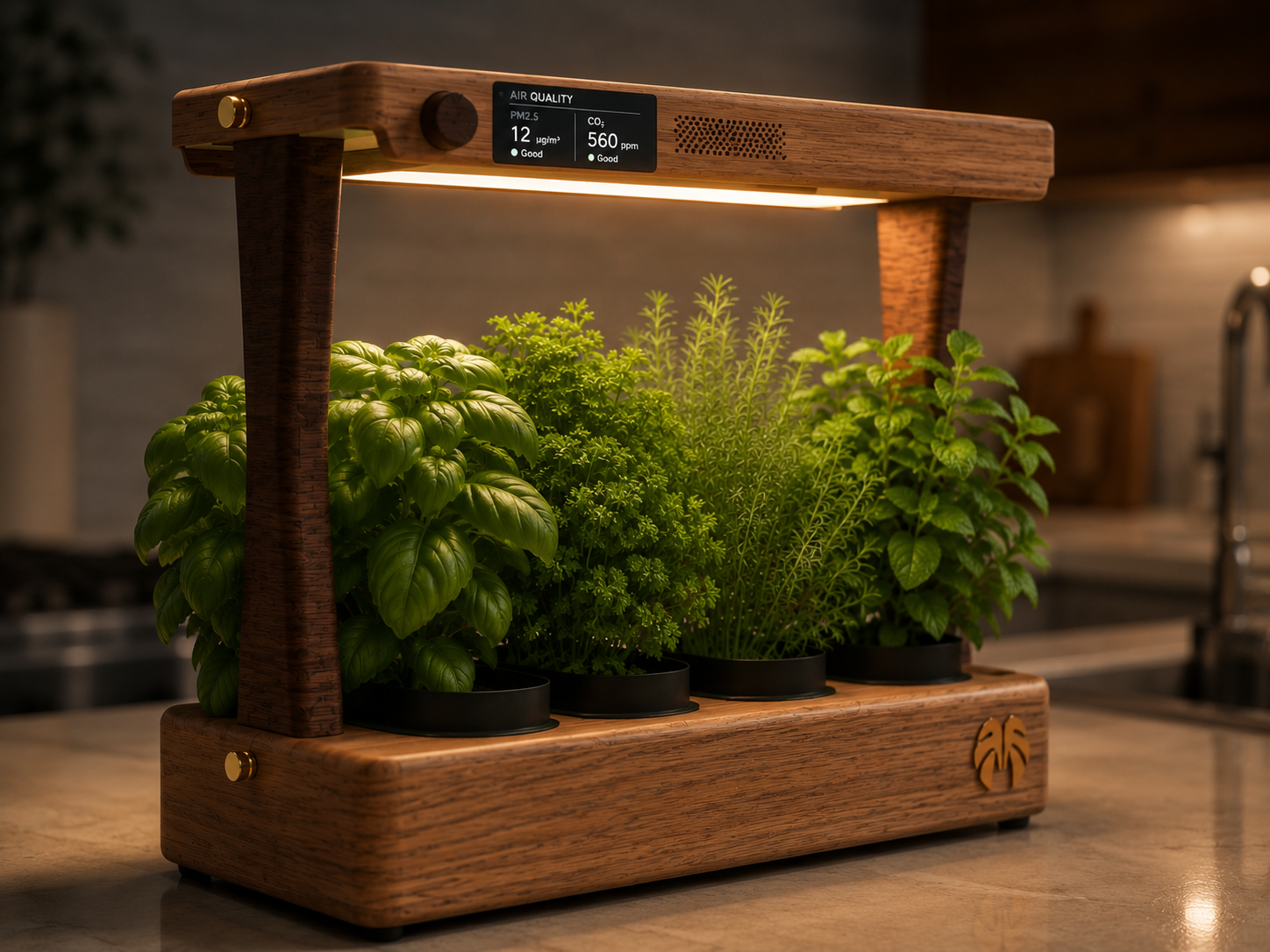
Aera by Monstera Labs
The first living object
designed around
what you breathe.
Solid hardwood. Full-spectrum light.
Continuous air sensing. Made in San Francisco.